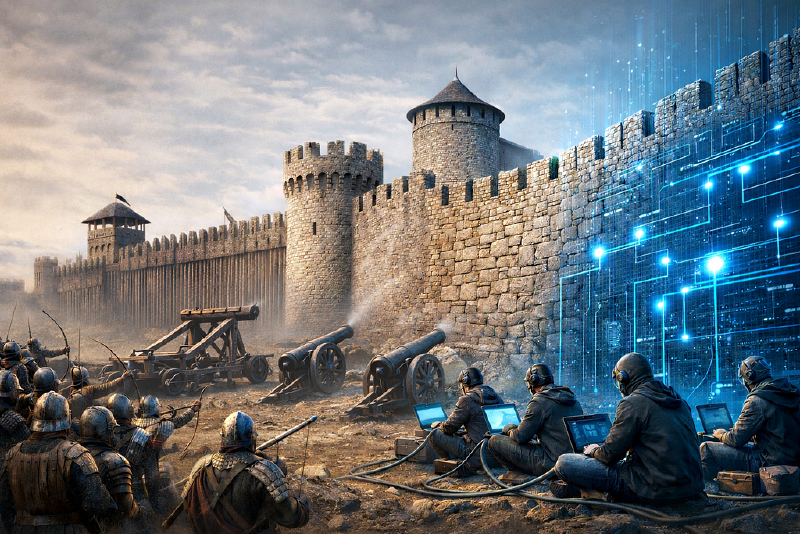
Every new weapon seems to arrive with a familiar announcement: this time, defense has finally lost. Artificial intelligence has inherited that role in today’s security headlines. A longer view makes the story less tidy, and more useful.
In Attack and Defense. A Brief Human History, from Stones to AI, I follow the contest between attackers and defenders from physical barriers to digital systems. A fence need not be impenetrable to matter. It can slow an intruder, reveal an approach, and give a community enough time to respond. Security begins with changing the conditions of an attack.
That pattern helps frame AI’s role. Models can assist deception, automate reconnaissance, and increase the scale of attacks. They can also help defenders analyze information and respond. The important questions concern costs, visibility, coordination, and who adapts more effectively as the tools change.
The essay also explores the limits of treating language models as reliable simulations of human behavior. An articulate imitation does not automatically provide an accurate account of how people will act under pressure.
The historical perspective offers no promise of safety. It offers a way to examine the threat without surrendering to spectacle: ask what has become easier, what remains constrained, and where defenders can create time and friction. The full article develops that argument across the changing technologies of attack and protection.