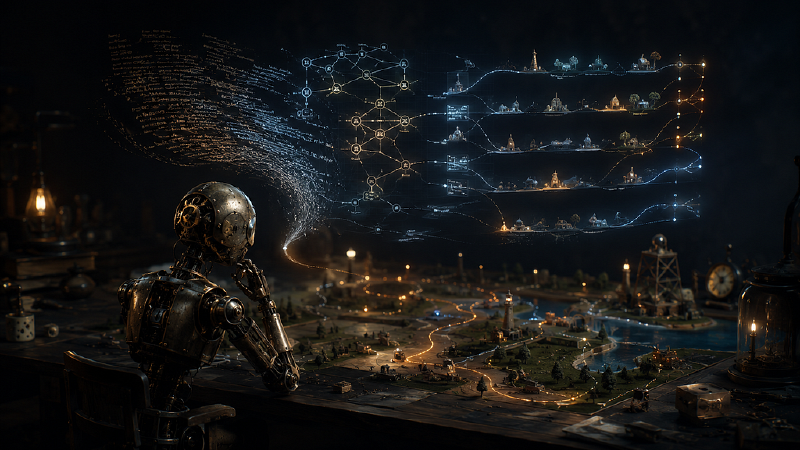
A convincing answer is one thing. A sequence of actions that still makes sense twenty steps later is another. Once a language model starts calling tools, editing code, or navigating software, its mistakes become part of the environment it must handle next.
In Intelligence as Simulation: Why LLM Agents Need World Models, I explore this gap between generating language and maintaining a direction through a changing world. An agent needs to track state, anticipate consequences, and revise its plans when reality pushes back. Fluency alone gives us little assurance that it can do those things reliably.
World models offer a way to represent how an environment changes under an action. Rather than merely suggesting the next step, a system can explore possible trajectories before committing to one. Sometimes an executable environment already provides that feedback: a test runner, a database, or a game engine can expose consequences directly. Internal simulation becomes especially valuable when trying things in the real world is slow, costly, or impractical.
The article examines how language and simulation might work together, with the model proposing possibilities and the environment constraining them. It leaves an important question open: how much of the world must an agent represent to act coherently over time? That uncertainty is where the discussion begins.